

Hybrid Cloud Observability
Enterprise hybrid environments span data centers, AWS, Azure, Google Cloud, and Kubernetes. Each platform generates signals, but separate tools often hide cross-system impact.
Virtana unifies hybrid cloud telemetry with dependency context, AI-driven intelligence, and automated remediation. Teams can trace issues across layers, prove root cause faster, and act with more confidence.
‘Virtana Has Given Us the Ability to Detect, Troubleshoot, and Correct Payment-Impacting Issues Within Minutes’
– Slade Weaver, Senior Manager, Core Data Platform, PayPal
Full-Stack Hybrid Cloud Observability
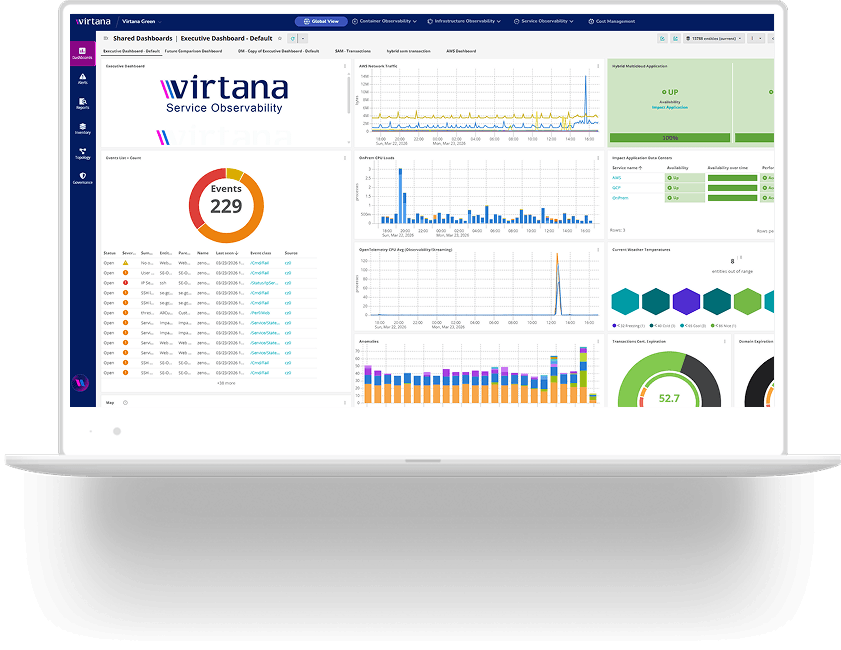
See Across On-Premises, Cloud, and Containers in One Platform
Hybrid cloud visibility breaks down when teams inspect cloud, container, network, storage, and application data separately. One tool may show resource pressure, while another shows latency, errors, or degraded service health. Neither view explains the delivery path on its own.
Virtana brings these signals into a single observability platform. On-premises, AWS, Azure, Google Cloud, and Kubernetes data remain connected to the same system view. Teams can see how compute, storage, network, data fabric, services, applications, and AI workloads interact.
With Infrastructure Observability, Virtana adds full-stack context and agentic AI for root cause analysis and remediation. That reduces dashboard stitching and helps teams move from signal review to action.
Cross-Layer Correlation
Connect Cloud Performance to Underlying Infrastructure Behavior
Cloud latency rarely starts and ends in one place. It can reflect compute contention, network congestion, storage delays, or AI workload demand.
Virtana’s Application Observability correlates application performance with the underlying infrastructure behavior.
Move teams from reactive alerting and wasteful war rooms to confirmed root cause and automated remediation across hybrid environments. Agentic AI analyzes cross-layer signals and identifies likely causes before teams lose time comparing separate tools.
Instead of moving through alerts one by one, teams can see the affected layer, related dependencies, and next steps.
Multi-Cloud Dependency Mapping
Map Service Relationships Across AWS, Azure, GCP, and On-Premises
Hybrid cloud changes can ripple across cloud services, on-premises systems, and Kubernetes clusters. A configuration update, an autoscaling event, or a workload move can affect downstream services within seconds.
Virtana’s System Dependency Graph uses dependency mapping to discover relationships across applications, services, containers, cloud resources, network paths, and storage.
Cross-layer topology discovery keeps that view up to date as environments change. This shared dependency view helps teams see what is connected, what changed, and what is affected.
Application, infrastructure, network, and cloud teams can align faster during incidents and planned changes.
Predictive Optimization for Hybrid Environments
Anticipate Cloud Constraints Before They Impact Services
Hybrid cloud sprawl can hide waste until performance or budget pressure appears. Teams may overprovision to reduce risk, while idle resources continue to consume spend in the long term.
Virtana connects cloud capacity management to live performance, capacity, and cost signals across hybrid environments. Predictive analytics and constraint-based optimization identify saturation, bottlenecks, and cost drift earlier.
This is especially relevant when growth touches VMware, Kubernetes, public cloud, and high-performance storage at once.
Automation helps keep resources right-sized as workload demand, placement, and cloud usage change. Teams can plan capacity based on the current system context, not on manual cleanup cycles.
Observability for AI Workloads
Extend Hybrid Cloud Observability Into AI Factory Environments
AI workloads bring different pressure patterns into hybrid cloud operations.
GPU clusters, model pipelines, and inference services can drive demand in ways that differ from those of traditional applications.
Virtana’s AI Factory Observability extends system-aware visibility into GPU performance, pipeline behavior, and AI workload dependencies. It connects AI infrastructure behavior to the same service and infrastructure context teams use elsewhere.
Teams can assess whether latency, saturation, or contention begins within the AI stack or in supporting systems.
Enterprises can move from AI pilots to production with less monitoring fragmentation.
Why Virtana for Hybrid Cloud Observability
Virtana is built for enterprise hybrid environments where service performance depends on many connected layers. Data centers, public clouds, VMware, Nutanix, Kubernetes, storage, and networks all shape the user experience.
With Virtana, teams can move through three operational steps: observe, triage, and remediate.
- See Service Health Across Domains: The single pane of glass monitoring view shows service health across hybrid environments, teams, and operational layers.
- Understand Cross-System Dependencies: System Dependency Graph and cross-layer topology discovery reveal relationships that dashboard-only tools often miss.
- Correlate Behavior With AI: Agentic AI analyzes telemetry and behavior across hybrid layers to identify likely causes, emerging constraints, and affected dependencies.
- Automate The Next Step: AI-driven intelligence connects to automated remediation, reducing the manual handoffs that slow hybrid cloud operations.
- Cover the Full Hybrid Stack: Infrastructure, Application, and AI Factory Observability work together in one platform, without disconnected legacy tools for every environment.
Want to Learn More? Resources:
Use these resources to evaluate monitoring consolidation across infrastructure, applications, and hybrid cloud operations.
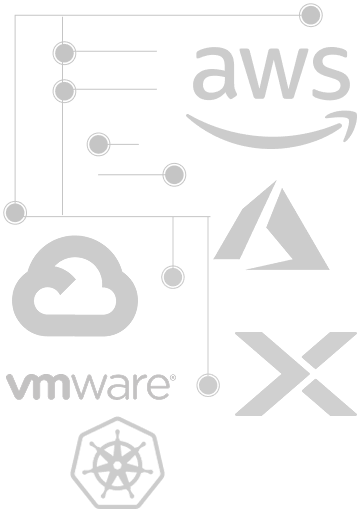
Integrations for Hybrid and Multi-Cloud Environments
Virtana supports the environments enterprise teams depend on most.
Trusted by Enterprise Teams

FAQs
Hybrid cloud observability connects telemetry, dependency context, and intelligence across on-premises, public cloud, and Kubernetes environments. It helps teams understand how AWS, Azure, Google Cloud, containers, and internal infrastructure interact. This goes beyond cloud-only or on-premises-only monitoring. It provides teams with system-level context across the entire hybrid environment and meaningful insights on system-impacting issues. That context matters as enterprises modernize applications, scale AI workloads, and operate more distributed services.
Hybrid cloud monitoring reports metrics across environments. Hybrid cloud observability explains behavior across them. It adds cross-layer correlation, dependency context, AI-driven root cause analysis, and automated remediation to raw telemetry. Monitoring may show latency, saturation, or errors. Observability helps teams understand why those signals appeared, which systems are involved, and what action should come next.
Enterprise teams should look for coverage across on-premises infrastructure, multi-cloud environments, containers, and AI workloads. The platform should integrate AWS, Azure, Google Cloud, VMware, Nutanix, and Kubernetes into a single system view. It should also provide full-stack dependency context, not just shared dashboards. Look for System Dependency Graph capabilities, cross-layer topology discovery, AI-driven root cause analysis, predictive analytics, and automated remediation. These capabilities help teams move from visibility to operational action.
Major observability vendors with multi-cloud coverage include Datadog, Dynatrace, New Relic, SolarWinds, Splunk, and Virtana. Virtana is purpose-built for enterprise hybrid environments that span on-premises, cloud, Kubernetes, and AI infrastructure. Its AI-native architecture goes deeper than APM-only or cloud-native-only coverage. System Dependency Graph and AI Factory Observability help differentiate Virtana, where hybrid infrastructure, service relationships, and AI workloads need shared context.
Virtana unifies and correlates telemetry across on-premises infrastructure, public cloud, Kubernetes, and AI workloads. Monitoring reports metrics across environments. Observability explains behavior across them and how to fix issues when they occur.
Observability adds cross-layer correlation, dependency context, AI-driven root cause analysis, and automated remediation on top of telemetry. Hybrid cloud monitoring shows that something is happening; hybrid cloud observability shows why and what to do about it.
AI workloads add GPU clusters, model pipelines, and inference services to hybrid cloud operations. These systems behave differently under load, but still depend on infrastructure, storage, networks, and services. Hybrid cloud observability connects AI performance to broader system behavior. Virtana’s AI Factory Observability brings GPU, pipeline, and AI workload telemetry into the same dependency context. Teams can operate AI workloads with clearer data on performance, capacity, and service impact.