

Hybrid Cloud Monitoring
Hybrid cloud complexity can make it difficult to understand how issues in one part of the environment affect the whole system.
Virtana delivers system-aware hybrid cloud monitoring with full-stack dependency context, AI-driven intelligence, and automated remediation. Empowered by this awareness, enterprise teams resolve issues faster and operate with greater confidence.
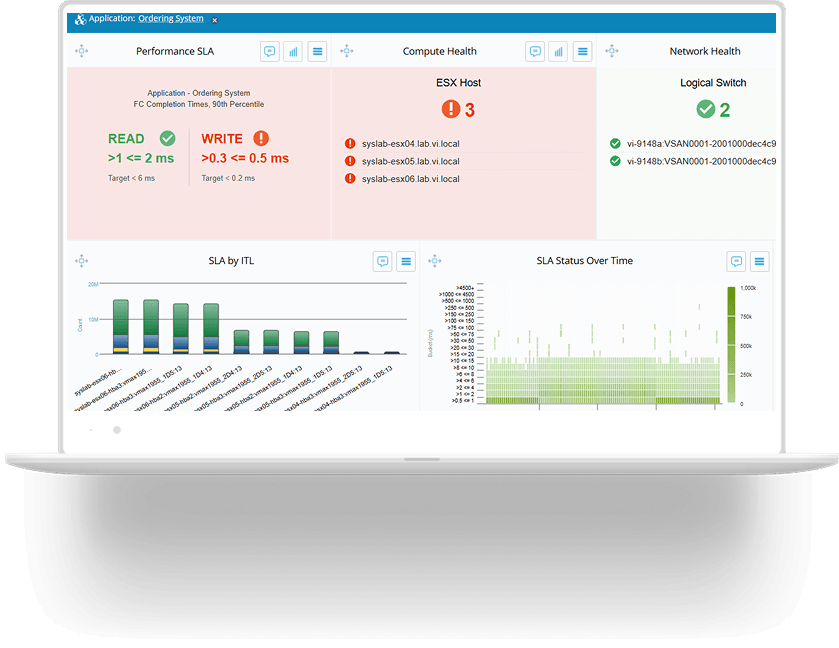
“If we didn’t have Virtana, our audiences would have a degraded experience and our reputation would suffer.”
Head of Monitoring, Global Media Organization

Hybrid Cloud Observability
Monitor Hybrid Cloud Performance Across the Full Infrastructure Stack
Hybrid cloud monitoring becomes harder when critical systems span disconnected environments. Virtana brings those environments into a unified view with hybrid infrastructure visibility.
- Monitor on-premises infrastructure, public cloud (AWS, Azure, GCP), and Kubernetes from a single platform.
- Connect compute, storage, network, data fabric, and application telemetry with full-stack dependency context.
- Understand how changes in one layer affect system-wide performance, availability, and cost. Accelerate troubleshooting and operational decision-making with unified hybrid cloud observability.
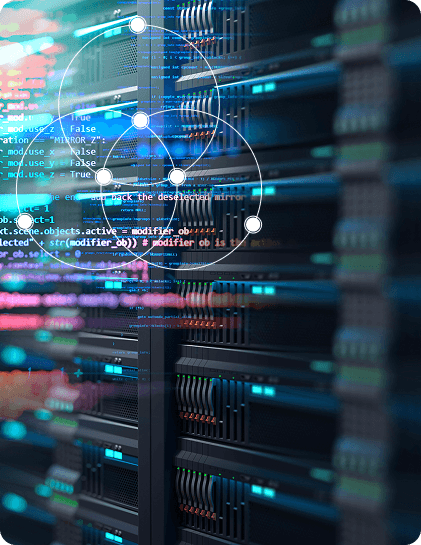
Hybrid Cloud Performance Monitoring
Isolate Constraints Across Cloud and On-Premises Using Agentic AI
Identify the likely source of performance issues and service disruption faster with AI that understands behavior across connected hybrid systems.
- Reduce noise from fragmented alerts across disconnected hybrid monitoring tools.
- Use AI-driven event correlation and intelligent root cause analysis to identify likely causes faster.
- Detect emerging performance constraints across cloud and on-premises infrastructure before they impact services or service level agreements (SLAs).
- Access these capabilities through Virtana’s unified observability platform, extending beyond traditional network performance monitoring.

Hybrid Cloud Dependency Mapping
Map Service and Infrastructure Relationships Across Cloud and On-Premises With a System Dependency Graph
See how infrastructure relationships shape system behavior during incidents, changes, and modernization efforts.
- Gain live visibility into relationships across cloud services, on-premises infrastructure, containers, and AI workloads.
- Automatically map dependencies with AI-driven topology discovery and dependency mapping, powered by a continuously updated system dependency graph.
- See how migrations, scaling events, and configuration changes affect connected systems during incidents and planned changes.
- Eliminate manual dependency tracing and improve shared visibility across infrastructure, operations, and engineering teams.

Hybrid Cloud Cost and Performance Optimization
Optimize Utilization, Capacity, and Cost Across Hybrid Environments and AI Pipelines
Make smarter infrastructure decisions with system-wide context and predictive intelligence.
- Identify overprovisioned resources, underutilized infrastructure, and emerging capacity constraints before they affect performance.
- Apply predictive analytics and automation to keep hybrid environments right-sized as demand changes.
- Align performance, capacity, and cost decisions within a unified platform instead of disconnected monitoring or FinOps tools.
- Extend intelligent cloud capacity management across hybrid infrastructure and AI Factory environments out of the box.

Enterprise-Grade Hybrid Cloud Monitoring
Designed for the Scale and Complexity of Hybrid Enterprise Environments
Support distributed enterprise infrastructure with observability built for operational depth, scale, and change.
- Unify visibility across on-premises data centers, AWS, Azure, GCP, VMware, Nutanix, Kubernetes, and connected infrastructure in a single platform.
- Automate operational workflows and remediation to reduce manual effort and improve resilience across complex environments.
- Provide enterprise teams with infrastructure intelligence that extends beyond traditional network observability.
- Adapt to modernization initiatives, architectural shifts, and evolving workload demands without adding monitoring fragmentation.

Why Virtana for Hybrid Cloud Monitoring?
Hybrid cloud monitoring tools often deliver more telemetry than clarity. Virtana connects infrastructure, services, applications, and AI workloads with system-level context. It helps enterprise teams understand both what happened and why.
Virtana’s System Dependency Graph and cross-layer topology discovery reveal infrastructure relationships that isolated monitoring tools miss.
Instead of forcing teams to manually connect fragmented signals across cloud, on-premises, and containerized environments, Virtana unifies operational context across the full hybrid environment. This helps teams make faster, more confident decisions.
Unlike other solutions, Virtana lets you:
- See with full-stack visibility across infrastructure, applications, services, and AI environments in a single platform.
- Understand likely constraints through agentic AI, intelligent event correlation, and root cause analysis instead of chasing disconnected alerts.
- Automate remediation workflows with operational automation that reduces manual handoffs and accelerates resolution.
Virtana combines three types of observability — Infrastructure, Application, and AI Factory — in a unified platform purpose-built for enterprise-scale, hybrid operations.
Resources
The Complete Guide to Hybrid Cloud Optimization:
Learn how enterprise teams reduce cost, improve performance, and make smarter infrastructure decisions across complex hybrid environments.
Compute Observability for Enterprise Servers:
See how deeper visibility into enterprise compute infrastructure helps teams identify constraints faster and improve operational resilience.
Understand how application-layer context helps connect infrastructure behavior to service performance across hybrid environments.
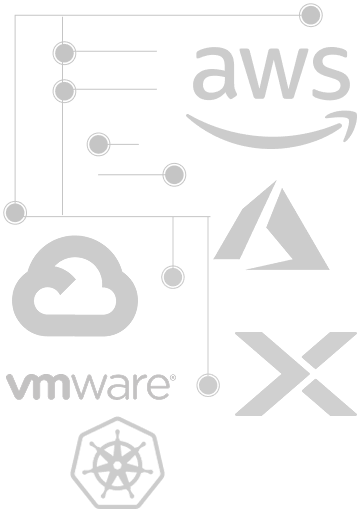
Integrations for Hybrid and Multi-Cloud Environments
Virtana supports the environments enterprise teams depend on most.
Trusted by Enterprise Teams

FAQs
A hybrid cloud monitoring solution should deliver a unified, system-level view across on-premises infrastructure, public cloud, containers, applications, and services. It should connect behavior in one layer to service impact across the broader environment.
This connection involves dependency context, AI-driven intelligence, and automated remediation. Enterprise teams also need support for performance, capacity, cost optimization, modernization initiatives, and increasingly complex AI workloads.
Hybrid cloud environments introduce complexity that isolated monitoring approaches are not designed to handle. Visibility is fragmented across cloud, on-premises, and containerized infrastructure. Therefore, it’s difficult to connect behavior in one layer to system-wide impact in another.
Dependency sprawl means a single change can cascade across connected systems without clear visibility, while disconnected tools generate siloed alerts that force manual investigation. Add dynamic workloads and growing AI infrastructure demands, and hybrid monitoring becomes fundamentally more complex than single-environment operations.
Virtana helps teams identify performance constraints faster by combining AI-driven event correlation, intelligent root cause analysis, and live dependency context across hybrid environments.
Its System Dependency Graph reveals how infrastructure behavior in one layer affects connected services and workloads. That reduces manual cross-tool investigation. Agentic AI continuously analyzes system behavior to surface emerging constraints before they impact SLAs, helping teams shift from reactive troubleshooting to proactive operations.
Virtana helps reduce modernization risk by showing how infrastructure changes and migrations may affect connected systems before changes are implemented. Dependency mapping and automated topology discovery maintain a current view of system relationships as environments evolve.
You can eliminate manual tracing across disconnected tools as well. At the same time, continuous hybrid monitoring validates post-migration performance, helping teams confirm intended outcomes and identify new constraints before they disrupt operations.
Hybrid cloud monitoring has evolved from siloed, metric-level visibility on individual devices into system-aware observability across interconnected environments.
Modern enterprise teams need more than alerts. They need dependency context, AI-driven correlation, and operational intelligence that connects infrastructure behavior to service impact across cloud, on-premises, containers, and AI workloads.
As hybrid complexity grows, monitoring platforms are increasingly expected to identify likely constraints, support automated remediation, and help teams move from reactive troubleshooting to proactive operations at scale.
Virtana goes beyond isolated domain monitoring by connecting behavior across applications, services, infrastructure, and AI workloads in a unified hybrid environment. Full-stack dependency context, cross-layer topology discovery, and AI-driven intelligence help teams understand system impact that point tools cannot discover at enterprise scale.
Traditional monitoring platforms stop at alerting. Virtana supports automated remediation and operational action through unified Infrastructure, Application, and AI Factory Observability.