Imagine this: a VP of Engineering at a healthcare company arrives on a Tuesday morning to discover two uncomfortable truths about their organization’s AI deployment.
The first – their patient-facing AI assistant had processed personally identifiable health information without proper masking for three days. The second – and arguably more unsettling – an adversarial probing campaign against their clinical Q&A model had been running for 72 hours straight. The Guardrails had blocked every attempt. Not a single malicious response made it through. By every measure, the safety layer had done its job.
But no one on the team knew the attack was happening.
The Guardrails stopped the damage. But the absence of observability meant the attack went undetected, uninvestigated, and – critically – unattributed. No incident report. No root cause analysis. No hardening of the perimeter. The adversarial actor could simply try again, with more sophisticated techniques, against a defense that didn’t even know it was under siege.
This is the enterprise AI security gap that most organizations don’t see until it’s too late.
The Stakes Have Changed
The scale and velocity of enterprise AI adoption in 2025 has outpaced the security posture of most organizations. Shadow AI – unsanctioned use of LLMs across departments – is now the number one AI governance concern for enterprises. AI-powered data leaks rank among the top five security threats, yet the majority of organizations lack specific controls to detect or prevent them.
Meanwhile, Agentic AI systems are introducing entirely new attack surfaces: identity gaps between AI agents and human users, token-level credential compromise, and data exfiltration through prompt manipulation. The EU AI Act has moved from aspiration to enforcement, imposing operational compliance obligations that demand verifiable AI governance – not just good intentions.
The enterprises that thrive in this environment will be those that can answer a simple question: Do we have visibility into what our AI systems are actually doing?
For most, the honest answer is no.
The Enterprise AI Blindspot
The visibility gap in enterprise AI deployments runs deeper than most leaders realize. It manifests across two critical dimensions – and most organizations are blind to both.
Blindspot #1: The Content Safety Gap
Without Guardrails, large language models are inherently unpredictable. They can generate biased, toxic, or off-brand responses. They can be manipulated through prompt injection attacks that bypass naive input validation. They can inadvertently expose personally identifiable information embedded in training data or user context.
This is the risk that most AI security strategies focus on – and rightly so. Content-level threats are real, measurable, and potentially catastrophic in regulated industries.
Blindspot #2: The LLM Behavioral Security Gap
But here is the dimension that almost no one is watching.
Consider: a healthcare organization runs five different LLMs through AWS Bedrock – one for patient intake summarization, one for clinical Q&A, one for internal knowledge search, and two more for back-office automation. Each team manages its own model. Each model has its own usage patterns.
Now imagine these scenarios:
- A 300% spike in prompt token volume at 2 AM on the patient intake model. Is it a legitimate batch processing job? Or is it an adversarial actor attempting to extract training data through systematic probing?
- Guardrails intervention rates on the clinical Q&A model tripling over a weekend. Are the Guardrails being too conservative? Or is someone systematically testing the boundaries with increasingly sophisticated prompt injection techniques?
- Elevated request failure rates on the knowledge search model. Is it an infrastructure issue? Or are compromised credentials being used to probe for unauthorized access patterns?
Without behavioral observability at the token level, every one of these scenarios goes undetected. The Guardrails may block individual requests. But the pattern – the signal that an organized attack campaign is underway – remains invisible.
Traditional APM and logging tools were built for web applications. They can track HTTP response codes, API latency, and database query performance. But they cannot distinguish a prompt token from a completion token. They cannot monitor Guardrails intervention rates. They cannot detect anomalous token consumption patterns that signal adversarial activity. They were never designed for the operational realities of LLM workloads – leaving a critical security gap in the one place enterprises need it most.
AWS Bedrock Guardrails – The Enforcement Layer
AWS Bedrock Guardrails addresses the content safety gap with a comprehensive, configurable set of safeguards that integrate directly into the generative AI workflow. It is, by design, a powerful enforcement mechanism – and it deserves to be understood on its own terms.
What Guardrails Enforce
Content Filters provide configurable thresholds for harmful content categories – hate speech, violence, sexual content, misconduct, and critically, prompt attack detection for both jailbreak and injection attempts. These filters operate across text and images, with organizations able to calibrate sensitivity levels per category.
PII Protection applies probabilistic detection and masking for sensitive data types – Social Security numbers, dates of birth, addresses, phone numbers – supplemented by custom regex patterns for organization-specific identifiers like patient IDs or internal account numbers.
Denied Topics and Word Filters enforce organizational policy at the content level. If the business says “never discuss competitor products” or “never reference off-label drug use,” the Guardrails enforces that policy consistently across every model interaction. No exceptions, no drift.
Contextual Grounding Checks address the hallucination problem directly – validating that model responses are grounded in the provided source material and relevant to the user’s actual query. This is particularly critical in regulated domains like healthcare and financial services, where fabricated information carries legal liability.
Automated Reasoning takes validation further, applying mathematical logic to verify that model outputs adhere to defined rules – and suggesting corrections when they don’t. It identifies unstated assumptions that could lead to incorrect conclusions.
Where Guardrails Operate
Effective security requires consistent enforcement regardless of how an LLM is consumed. To accommodate different AI architectures, AWS Bedrock Guardrails can be implemented natively across four key touch points:
- Model Inference: Evaluating submitted prompts and generated responses during direct interactions with a foundation model.
- Agents: Securing autonomous AI agents by applying policies to both the inbound prompts and the responses returned by the agent.
- Knowledge Bases: Protecting Retrieval-Augmented Generation (RAG) deployments by evaluating queries and ensuring the generated responses meet safety standards.
- Flows: Securing complex, multi-step workflows by attaching Guardrails directly to specific prompt or knowledge base nodes.
What Guardrails Don’t See
Bedrock Guardrails excels at content-level protection. It is precisely what enterprises need to ensure that LLM outputs are safe, compliant, and aligned with organizational policy.
But content is only one dimension of the enterprise AI security challenge.
Who is monitoring the Guardrails themselves?
If your content filter trigger rate spikes 300% overnight, is that a more cautious model configuration – or an active prompt injection campaign? If one model suddenly generates ten times its normal completion token volume, is that a legitimate new feature – or a data ex-filtration attempt? If request failure rates climb steadily across a specific model, is it an infrastructure degradation – or systematic adversarial probing?
Guardrails enforce policy. But enforcement without observability is defense without intelligence.
Enterprises consuming models from multiple providers in AWS Bedrock – need not only a consistent safety layer, but also a consistent observability layer to detect anomalies and behavioral shifts across all of them.
This is where the security equation remains incomplete.
Virtana AI Factory Observability – The Detection Layer
This is the gap that Virtana AI Factory Observability (AIFO) was designed to fill.
Return to the healthcare organization. They deployed Bedrock Guardrails six months ago. PII is being masked. Denied topics are blocked. Hallucination checks are active across all five models.
And yet:
No one can see that the clinical Q&A model’s Guardrails are triggering 400% more frequently this week than the historical baseline. A 2 AM spike in prompt tokens on the patient intake model goes entirely undetected. The elevated request failure rate on the knowledge search model – 15% and climbing – suggests that something is systematically testing its boundaries.
The Guardrails are doing their job. But no one is watching the Guardrails work.
Token Patterns as Security Intelligence
Virtana AI Factory Observability (AIFO) provides unified LLM observability across the enterprise AI estate – treating every token pattern, every utilization shift, and every request anomaly as a potential security signal.
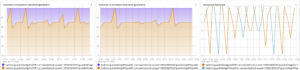
The Virtana AIFO Token Usage Dashboard tracks prompt tokens, completion tokens, model utilization breakdowns, Time to First Token (TTFT), request throughput, and success/failure rates across every model in the environment. But the power isn’t in the metrics themselves – it’s in what the patterns reveal.
Every anomalous token pattern is a potential security signal. Observability turns those patterns from noise into intelligence.
Virtana AIFO Token Consumption Trends provide historical analysis that correlates token volume spikes with known events – or surfaces unknown anomalies. When a model’s prompt token volume spikes 200% at 2 AM, the security team needs to know whether it was a scheduled batch job or the beginning of an adversarial campaign – in real time, not in a post-incident review.
Request Analysis for Threat Detection
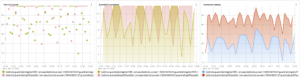
Virtana AIFO Request Analysis and Error Tracking moves beyond simple uptime monitoring. Elevated failure rates don’t just degrade user experience – they signal potential adversarial probing, credential misuse, or Guardrails evasion attempts. A model that historically runs at a 2% failure rate suddenly climbing to 15% is not a performance issue. It’s a security event.
Watching the Guardrails Work
Perhaps the most critical capability – and the one that directly addresses the gap in the current enterprise AI security posture – is Guardrails intervention monitoring.
If your Guardrails are triggering five times more than baseline, that is not noise. That is an active attack campaign testing your defenses. Without observability over Guardrails behavior itself, the enterprise is enforcing policy blind – blocking individual threats without understanding the broader pattern, the campaign’s sophistication, or its ultimate objective.
Virtana AIFO makes Guardrails activity observable. Trigger frequencies are tracked. Blocked-topic patterns are analyzed. Intervention rate trends are surfaced. The security team doesn’t just know that a Guardrails fired – they know how often, against which model, in what pattern, and with what trajectory.
This is the difference between enforcement and intelligence. Between blocking an attack and understanding one.
The Convergence – AWS Bedrock Guardrails + Virtana AIFO
When AWS Bedrock Guardrails and Virtana AIFO (AI Factory Observability) are deployed together, the enterprise achieves something neither can deliver alone: true defense in depth for AI.
The Two-Layer Architecture
Layer 1: Enforcement (AWS Bedrock Guardrails). Bedrock Guardrails evaluates every prompt and response at the content layer – filtering harmful content, masking PII, enforcing topic policies, validating grounding, and running automated reasoning checks. Every interaction passes through a configurable, model-agnostic safety layer. This is the policy enforcement engine.
Layer 2: Detection (Virtana AIFO). Virtana AIFO simultaneously monitors the behavioral layer – token consumption patterns, model utilization shifts, request anomalies, and Guardrails intervention rates. This is the security intelligence engine.
Together, they create a closed security loop. The Guardrails blocks a malicious request. The observability layer detects that the Guardrails has blocked fifty malicious requests in the past hour, all from the same request pattern, all targeting the same model. The Guardrails enforces the policy. The observability reveals the campaign.
A 300% increase in content filter triggers might indicate a prompt injection attack campaign. A sudden shift in prompt/completion ratios across a model could indicate data exfiltration. Without observability, the Guardrails silently blocks the request – but the security team never learns an attack is underway.
Back to the Healthcare Organization
With both layers deployed, the picture changes fundamentally.
The compliance team can now verify exactly which models are processing patient data, what Guardrails are active on each, and demonstrate PII masking effectiveness to auditors – with verifiable evidence, not assurances.
The security team sees a real-time view of Guardrails intervention rates across all five models. When the clinical Q&A model’s PII filter triggers jump 400% over a weekend, they detect and investigate the adversarial probing campaign within hours – not weeks. The attack is attributed, the source is blocked, and the Guardrails configuration is hardened before the attacker can iterate.
The AI operations team correlates a sudden TTFT degradation on the patient intake model with an anomalous spike in request volume – identifying either a DDoS-style attack or an unauthorized internal bulk-query script. The behavioral signal from the observability layer triggers investigation before the model’s availability is impacted.
Regulated Industries and Data Sovereignty
For healthcare, financial services, and government agencies where data sovereignty requirements are strict, the ability to deploy observability infrastructure on-premises with tenant-level data segregation – and to use customer-managed LLM models for in-platform analytics – eliminates a significant compliance barrier. Defense in depth is not just a security posture. In regulated industries, it’s a compliance requirement.
Achieving Secure, Observable AI Operations
Now reimagine that Tuesday morning scenario – but with both layers in place.
With Bedrock Guardrails deployed, the PII exposure never happens. The Guardrails mask patient health information consistently and verifiably across every model interaction.
With Virtana AIFO providing LLM observability, the adversarial probing campaign is detected within the first two hours – not discovered after 72. The 300% spike in Guardrails triggers – the behavioral signal of the attack – surfaces immediately in the Token Usage Dashboard. The ITOps team investigates, attributes the source, blocks the actor, and hardens the Guardrails configuration. An incident report is filed. A root cause analysis is completed. The defense perimeter has learned.
The Guardrails did their job.
The real issue? No one was watching the Guardrails work. Enforcement without observability is defense without intelligence.
Enterprise AI is now an operational reality-serving critical workflows and processing sensitive data at scale. This demands true defense in depth.
Every model observed. Every Guardrails monitored. Every anomaly investigated.
Guardrails protect your LLMs. Virtana AIFO ensures your enterprise is proactively defended.

Sankar Nagarajan
Principal Data Scientist