

AIOps

AI FACTORY REALITY CHECK: 2026 Enterprise Research on Observability, GPU Cost and Governance Gaps
New research on AI factory observability, GPU utilization, and the governance debt slowing enterprise AI at scale
Why Enterprises Are Scaling AI Factories Faster Than They Can Operate Them
In March 2026, Virtana’s “AI Is Breaking Human-Managed Operations” research found three in four enterprises reporting double-digit AI job failure rates, with executive confidence rising while operational fragility rose faster. The study found that human-scale operations cannot sustain machine-scale AI systems.
Two months later, a more consequential pattern has emerged. AI factories are scaling faster than the system managing them.
Enterprises are racing to deploy AI factories, acquiring GPUs as quickly as they become available while rapidly building the infrastructure to support them. Yet Virtana’s “AI Factory Reality Check,” based on a survey of 788 U.S.-based decision-makers and practitioners, finds that the governance, operational controls, and system-level observability needed to run AI factories at scale are failing to keep pace. As AI demands accelerate, organizations are struggling to establish the visibility, accountability, and control necessary to understand, optimize, and govern AI systems, exposing a widening gap between AI factory expansion and the operational foundation needed to sustain it.
This study examines the condition of the systems now carrying this load. The findings show that more than half of enterprises are already scaling AI across teams, with many managing the most operationally demanding state: running live production workloads while expanding infrastructure at the same time.
At the same time those systems are scaling, they are being actively reconfigured. Rising hardware costs are pushing enterprises to rebalance workload placement across the hybrid environments they already operate and to consolidate infrastructure in pursuit of efficiency. These changes are happening while systems are live, under load, and expanding, introducing additional complexity into environments that are already difficult to observe and control.
The operational systems required to manage this complexity have not kept pace. Teams responsible for AI factory environments are operating with limited visibility, inconsistent performance baselines, and a continued reliance on manual investigation when systems fail.
Where the March research found a divide in readiness confidence, this study finds one in operational reality. Practitioners report materially lower levels of visibility and control than the leaders authorizing their expansion, and that divergence shapes investment decisions made against an incomplete picture of how these systems behave.
Enterprises are under increasing pressure to demonstrate returns on significant AI infrastructure investments. The instrumentation required to produce that proof, including cost governance, performance visibility, and cross-domain accountability, is precisely what is being deferred.
Organizations are deploying AI systems with the expectation they will deliver business value, yet they lack the operational visibility to prove those outcomes are occurring. You cannot govern what you cannot see.
Capital continues to flow toward models, applications, and outputs, the most visible layers of AI. When AI factories are treated as outputs rather than systems, risk accumulates in the least visible layers, including infrastructure orchestration, workload coordination, resource utilization, and operational governance. You cannot govern what you cannot see, and the data shows enterprises are scaling systems they cannot yet fully see.
Monitoring visibility gaps reach every layer of the AI factory stack: data pipeline visibility (52%), storage and throughput (47%), network bottleneck detection (44%), and lack of centralized dashboards (34%) follow closely behind cost and GPU tracking.
Key Findings: AI Factory Visibility, GPU Cost, and Root Cause Analysis Gaps
AI Factory Scale and Operational State
54% of enterprises are already scaling AI across teams, with a further 23% managing live production workloads alongside active infrastructure expansion, the most operationally demanding state of all.
The AI Factory Visibility Crisis
- 1 in 4 enterprises still runs a manual investigation across tools as its first response when an AI workload underperforms or fails. Teams are manually assembling context across disconnected consoles while expensive compute sits underutilized.
- Nearly 6 in 10 enterprises (59%) cannot automatically identify root cause across all infrastructure domains when an AI workload alert fires. Only 41% have automated, cross-domain root cause identification in place.
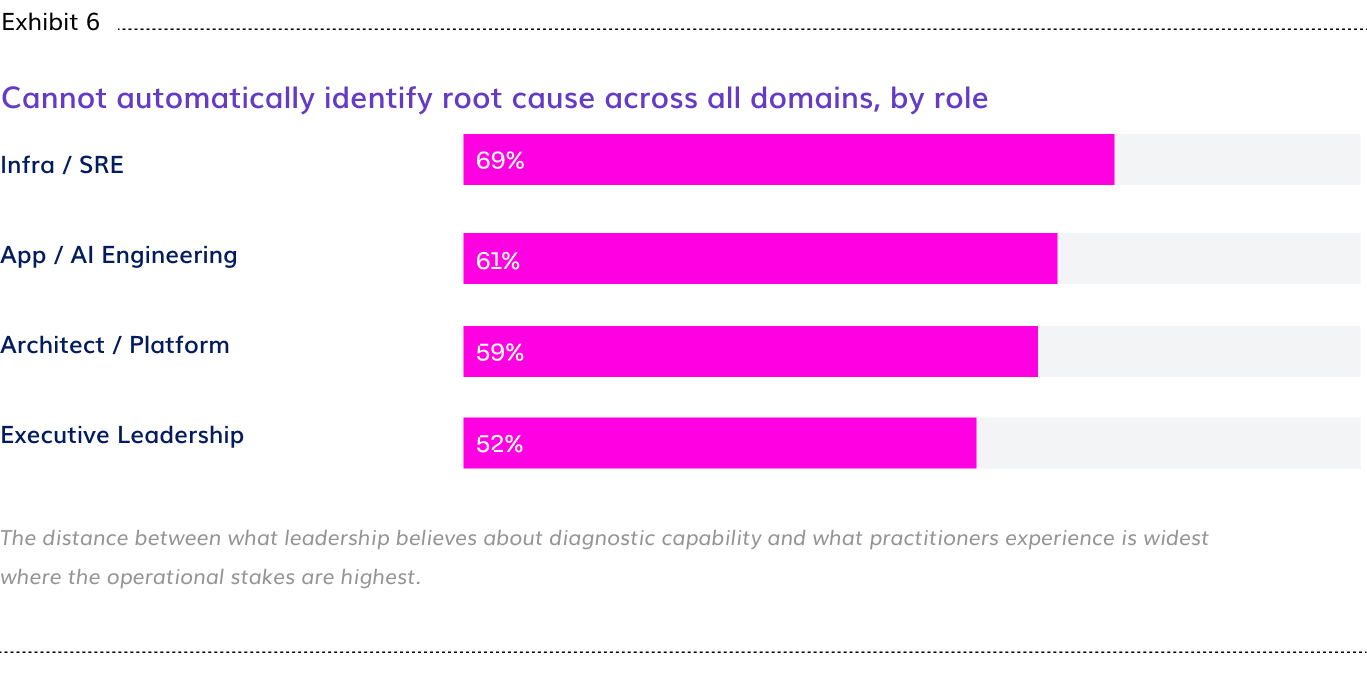
- 69% of Infra/SRE practitioners cannot automatically identify root cause across all infrastructure domains, compared to 52% of executives reporting the same limitation, a 17-point divergence between the teams managing the factory floor and the leaders authorizing its expansion.
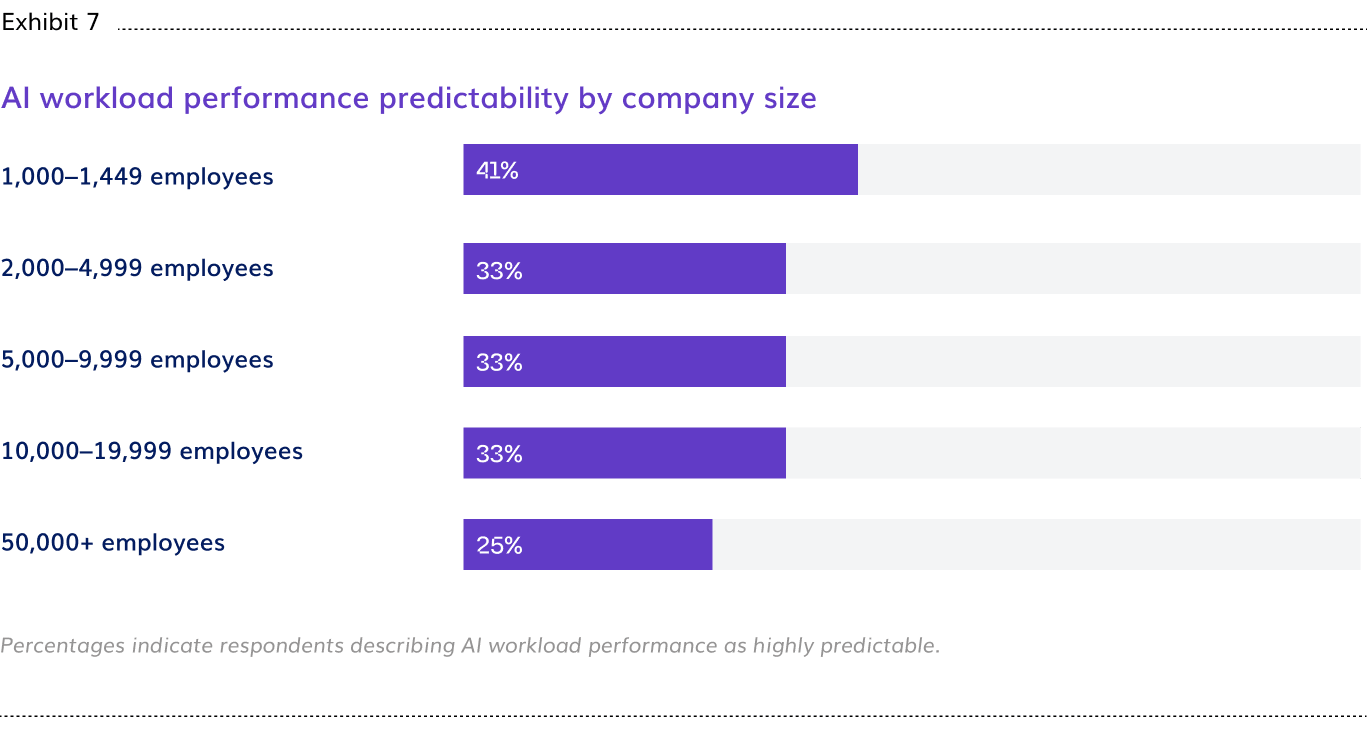
- Two-thirds of enterprises are operating AI factory infrastructure without reliable performance baselines. Only 34% describe AI workload performance as highly predictable, a figure that falls to 25% at organizations above 50,000 employees. The larger the factory, the harder it is to anticipate what it will do next.
- Cost and efficiency metrics (57%) and GPU utilization tracking (56%) are the top two monitoring challenges. Organizations are acquiring GPU infrastructure at significant cost without the visibility to confirm it is running efficiently.
- Monitoring blind spots reach every layer of the AI factory stack: data pipeline visibility (52%), storage and throughput (47%), network bottleneck detection (44%), and lack of centralized dashboards (34%) follow closely behind cost and GPU tracking.
Where AI Governance Breaks Down
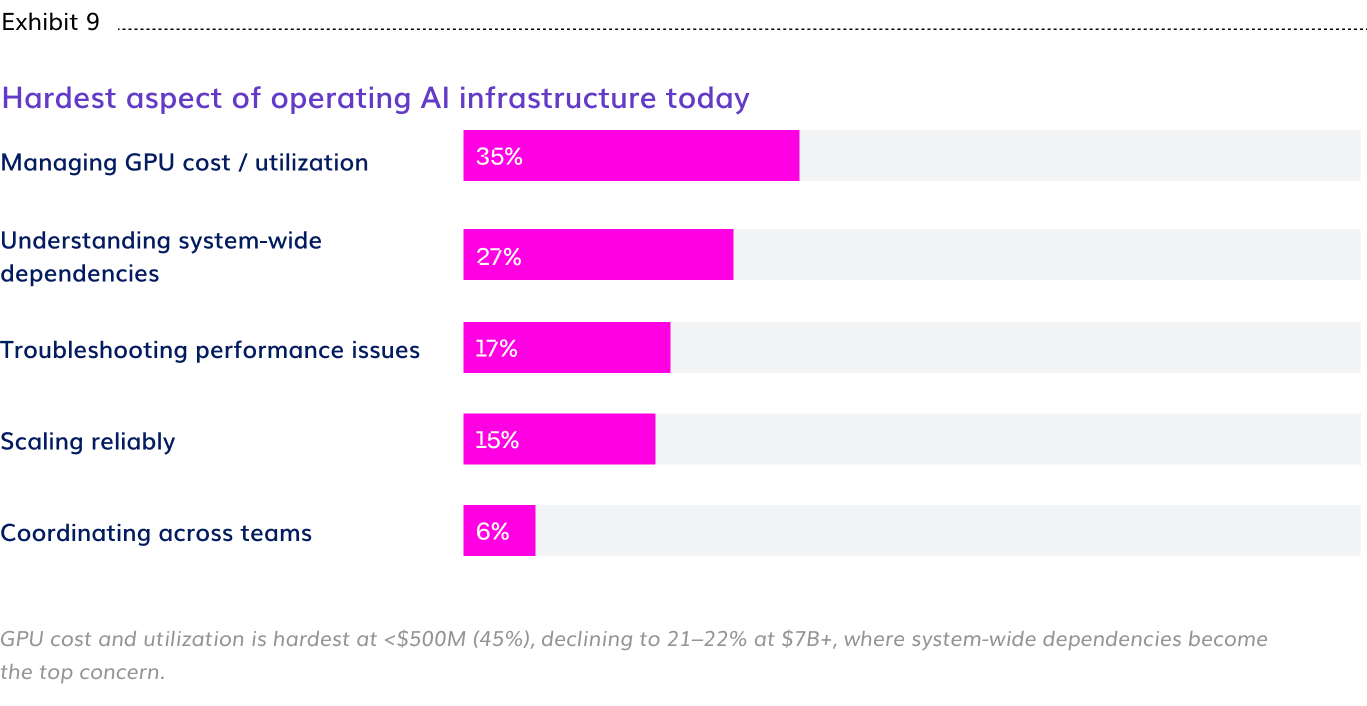
- Managing GPU cost and utilization is the hardest operational challenge for more than 1 in 3 enterprises (35%). Executives feel it as financial accountability pressure (39%). Architects feel it as the complexity of integrating high-performance hardware into distributed environments (36%). Infra/SRE teams feel it as the daily challenge of scaling reliably (22%).
- 50% of enterprises are deprioritizing security and compliance reviews as AI factory demands grow, 11 points above UK peers.
AI Hardware Costs Reshaping Infrastructure Investment
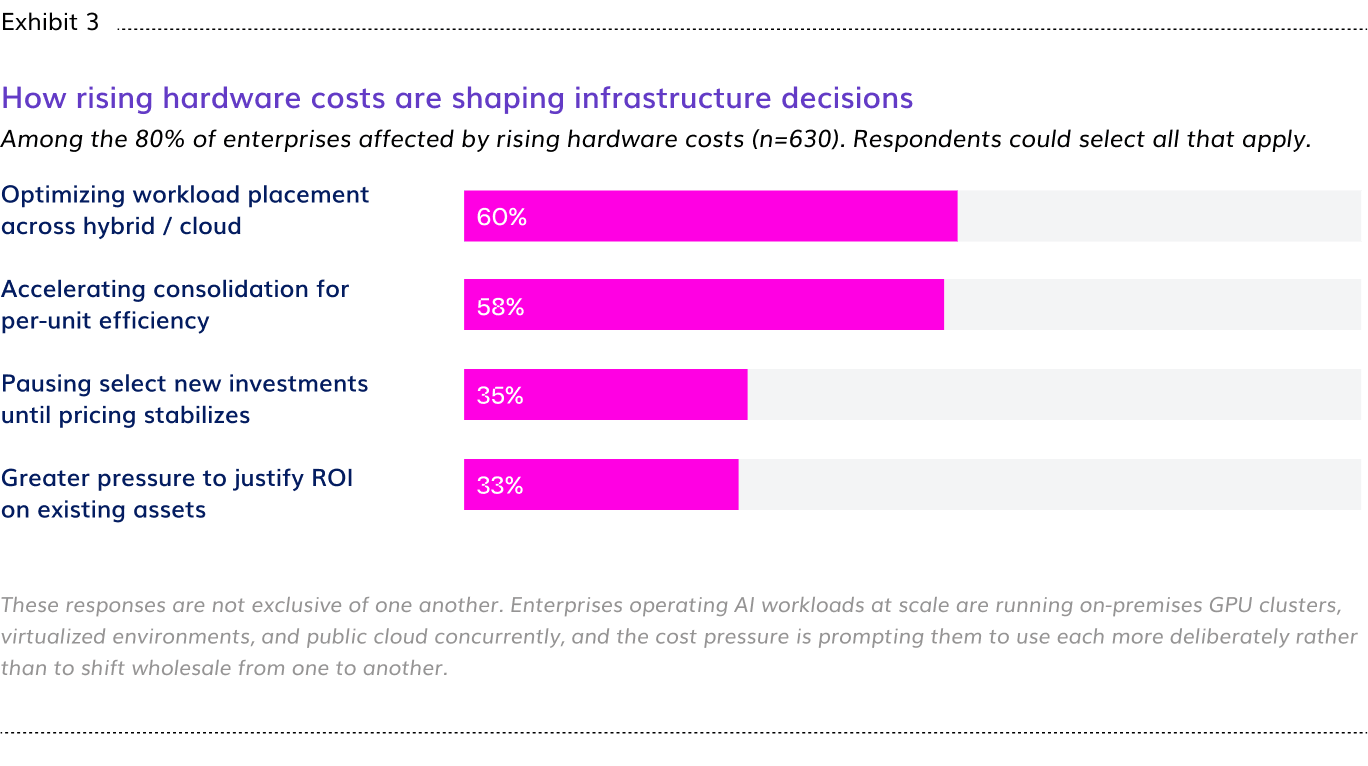
- 80% of enterprises say the cost of premium AI hardware has changed how they approach infrastructure investment decisions, the highest rate of any segment in the study. Among those affected, 60% are optimizing workload placement across hybrid environments and 58% are accelerating consolidation to improve per-unit efficiency.
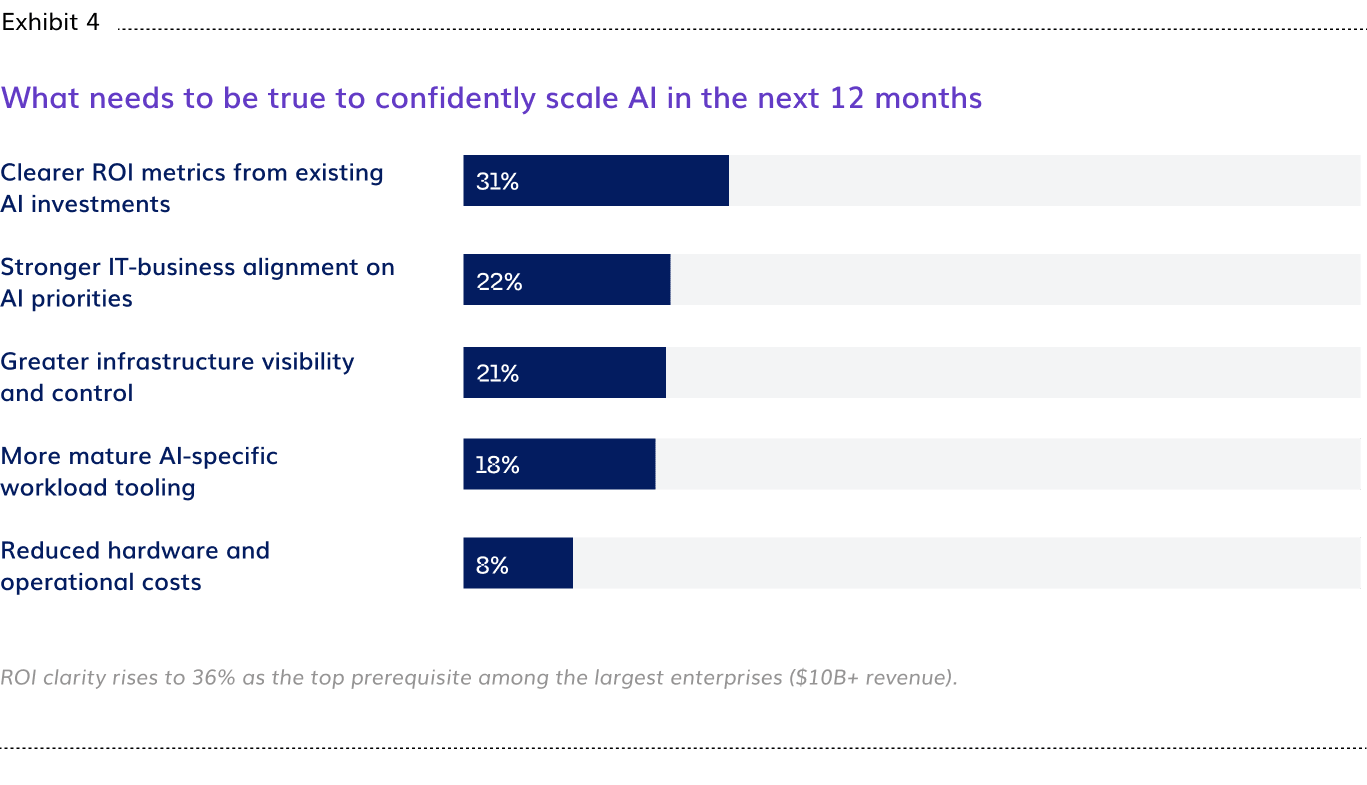
- 31% of enterprises cite clearer ROI metrics from existing AI investments as the single most important prerequisite for confidently scaling AI in the next 12 months, ahead of IT-business alignment (22%), infrastructure visibility (21%), and mature tooling (18%).
What Enterprises Want Next: Unifi ed AI Factory Observability and Automated Root Cause Analysis
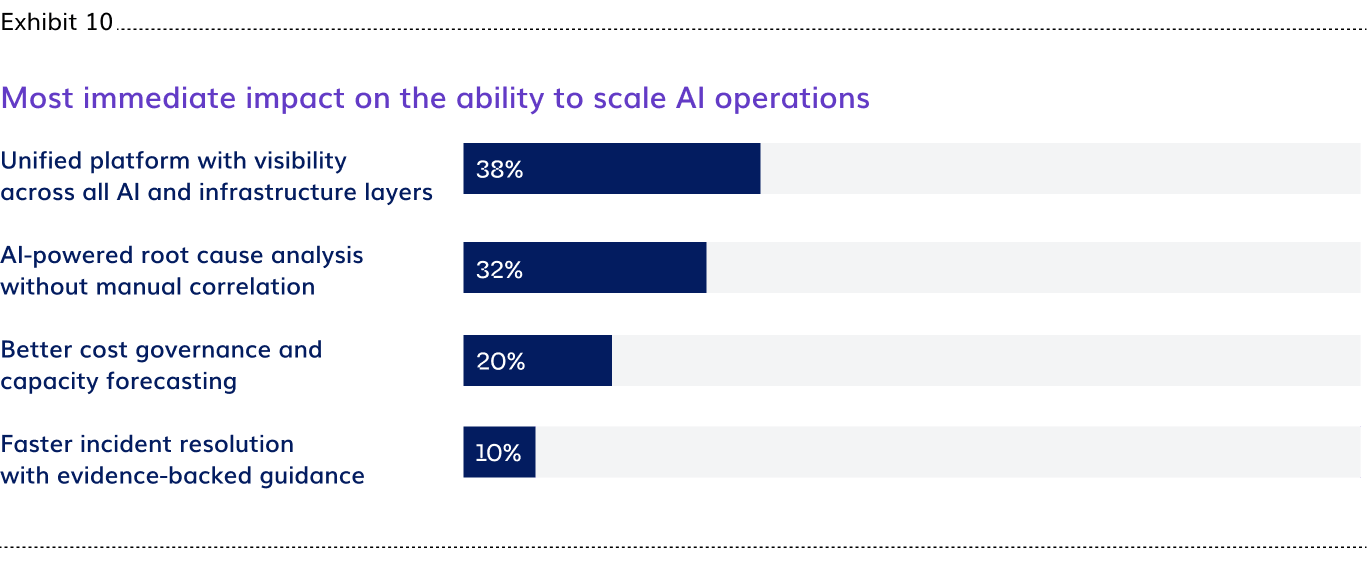
- 70% of enterprises converge on the same two immediate operational priorities: a unified platform with visibility across all AI and infrastructure layers (38%) and AI-powered root cause analysis that works without manual correlation (32%). This is consistent across all role groups and revenue bands.

AI Factories Are Scaling Without the Systems to Control Them
Enterprise AI has entered its operational phase. More than half of enterprises are already scaling AI across teams, and a further 23% are running live AI workloads in production while simultaneously expanding their infrastructure footprint. These organizations face the most concentrated operational demands to maintain production reliability while continuing to grow the surface they are responsible for.
54%
Already scaling AI across teams
23%
Running production workloads while expanding infrastructure
14%
Operating early production workloads
At the largest enterprises, the complexity intensifies. Organizations above $10 billion in revenue are the most likely to be managing simultaneous production and expansion, reflecting AI factories of exceptional scope.
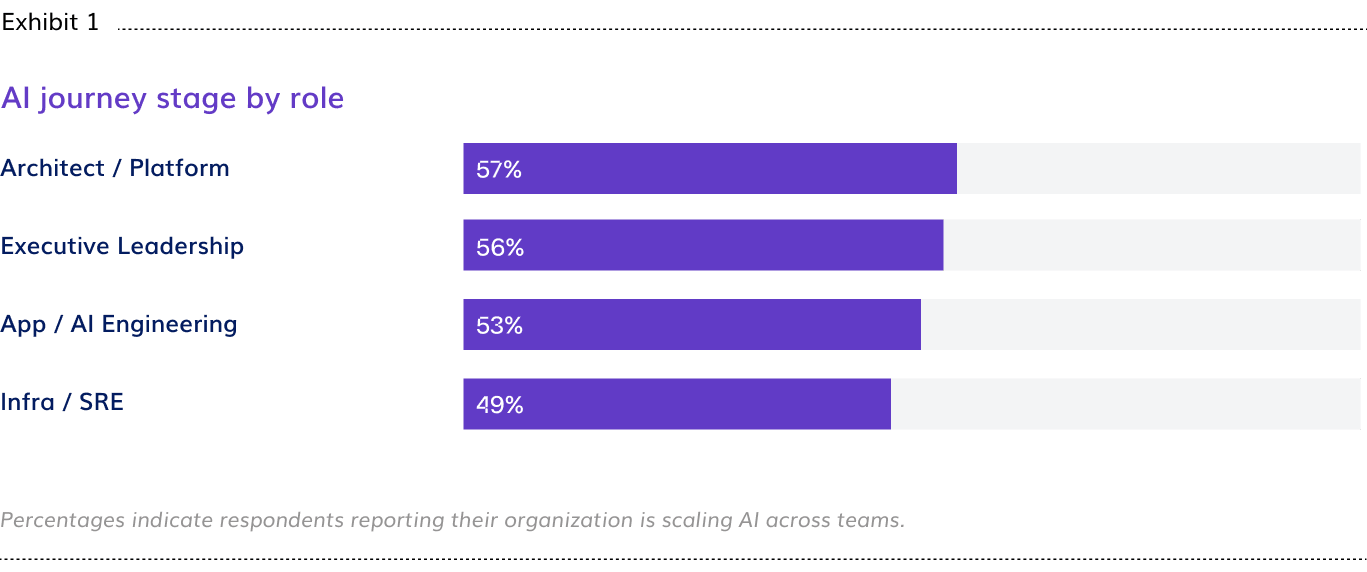
As factories scale, adding GPU clusters, expanding data pipelines, and onboarding concurrent workloads, the operational surface grows faster than the visibility infrastructure managing it. The practitioner’s view makes this visible. Infra/SRE teams report scaling at 49%, the lowest of any role group, with 21% still managing early production workloads. Executives report scaling at 56%. The people running the factory floor and the leaders overseeing it are describing two different operational environments.
Governance and controls are being deferred at the same time
As AI factory demands grow, the work required to establish visibility, accountability, and control is being sidelined. Cost optimization is deprioritized by 54%, legacy infrastructure modernization is deferred by 56%, and security and compliance reviews are scaled back by 50%. Enterprises are racing to build out AI factories while simultaneously cutting the governance and instrumentation work that would let them operate those factories with confidence.
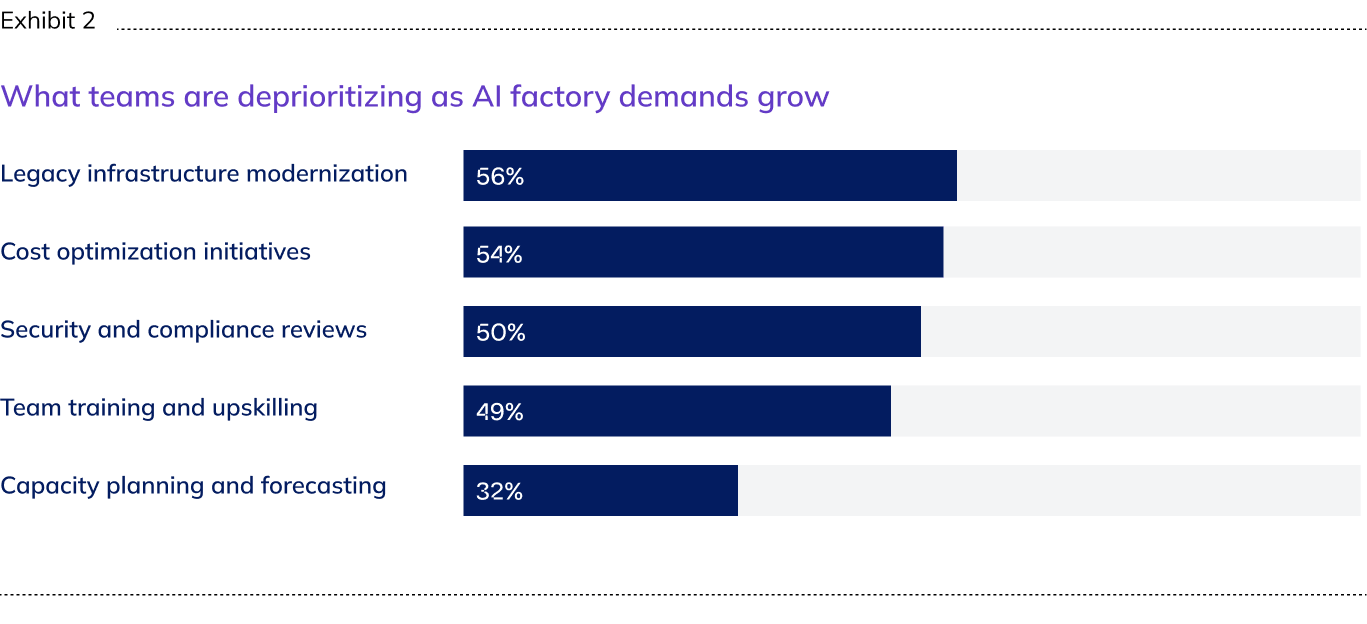
Security and compliance reviews are being deprioritized by 50% of US enterprises.
AI Infrastructure Investment Pressure: Premium GPU Costs Reshape Enterprise Decisions
The build-out documented in the previous section is happening against a financial backdrop that shapes how enterprises approach every infrastructure decision. Premium AI hardware is in short supply and high demand, and enterprises are paying close attention to how every dollar of capacity is allocated. They are rebalancing workload placement across the hybrid environments they already operate and consolidating systems to improve per-unit efficiency, all while AI factories are live, under load, and continuing to expand. This operational change is happening in motion and not in controlled conditions.
80%
of enterprises say the cost of premium AI infrastructure has changed how they approach investment decisions
Eight in ten enterprises say the cost of premium AI hardware has changed how they approach infrastructure investment decisions. Among those affected, 60% are optimizing workload placement across the hybrid environments they already operate, and 58% are accelerating consolidation to improve per-unit efficiency. A further 35% have paused select new investments until pricing stabilizes, and 33% report greater pressure to justify ROI on existing assets. These are the responses of organizations feeling the weight of AI infrastructure spend and actively managing it.
The ROI prerequisite
More than any other factor, enterprises identify clearer ROI as the primary prerequisite for scaling AI further, cited by 31%, ahead of IT-business alignment (22%), infrastructure visibility (21%), and mature tooling (18%). The demand is for proof that the factory is working, not for more capability.
Visibility is the prerequisite for operational control. Enterprises need evidence that their AI factories are working at the scale they have built. The instrumentation required to produce that evidence is what is being deferred.
Inside the AI Factory,
Where Control Breaks Down
The operational consequences of this imbalance are visible across how AI factories operate at scale. They show up in how teams respond when something breaks, how reliably they can predict workload behavior, and how much of the factory they can see.
When something breaks
A quarter (25%) of enterprises still run a manual investigation across tools as their first response when an AI workload underperforms or fails. For teams managing GPU-dense environments, that means engineers pivoting between infrastructure consoles, virtualization layers, and application dashboards to manually reconstruct what happened, while expensive compute sits underutilized waiting for a resolution that the tooling cannot accelerate.
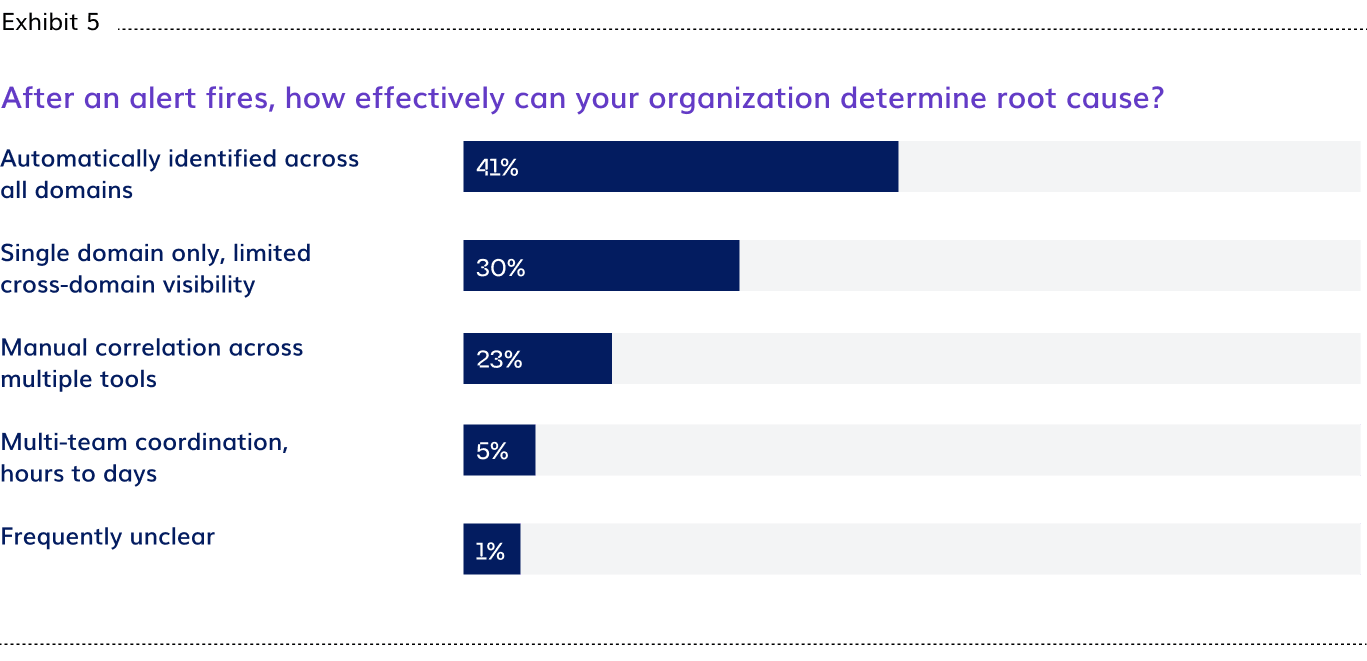
The divide between how executives and practitioners experience this is the sharpest in the dataset. More than half (69%) of Infra/SRE practitioners, the engineers who field those alerts, report their organizations cannot automatically identify root cause across all domains. Among executives, 52% say the same. That 17-point difference reflects what it feels like to be the person on call when a GPU workload degrades at 2am with no automated diagnosis to work from.
Predicting what the factory will do next
Beyond incident response, there is the more persistent challenge of not knowing how AI workloads will behave from one run to the next. Performance variability makes capacity planning approximate, SLA commitments unreliable, and cost forecasting a guessing exercise. Teams managing AI factories at scale are responsible for infrastructure whose behavior they cannot consistently anticipate.
34%
Describe AI workload performance as highly predictable
26%
Highly predictable among Infra/SRE practitioners
25%
Highly predictable at organizations above 50,000 employees
What teams can and cannot see
Cost and efficiency metrics (57%) and GPU utilization tracking (56%) are the top two monitoring challenges. GPU infrastructure is being acquired and deployed, but the instrumentation to know whether it is running efficiently is a challenge across every role group. The breadth of what teams cannot see confirms that the visibility problem runs the full length of the AI factory stack.
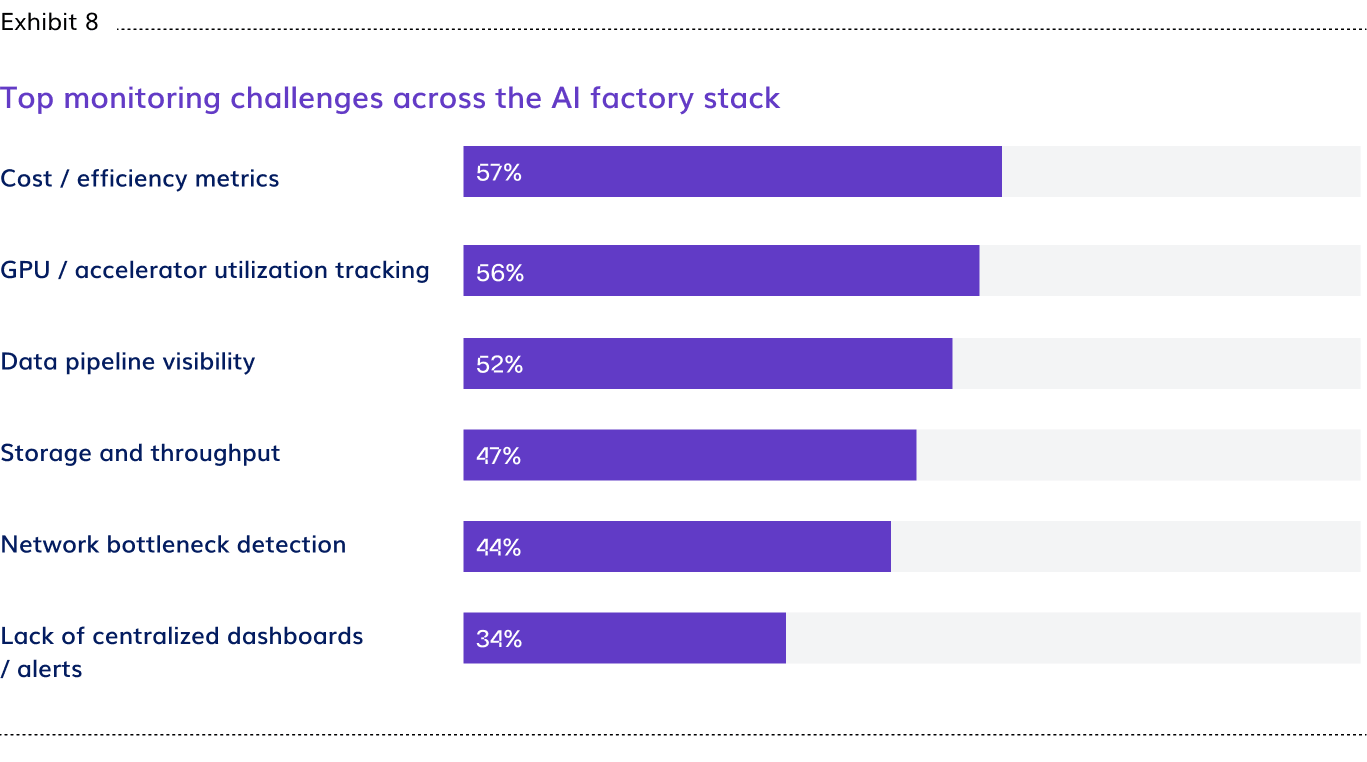
Each team encounters a different face of the same full-stack problem. Infra/SRE teams lead on network bottleneck detection (48%), reflecting where they operate in the stack. Architects lead on data pipeline visibility (62%), reflecting the supply chain view of the AI factory. Executives and App/AI Engineering both flag GPU utilization tracking at 61% and 60% respectively, the asset accountability layer where financial and operational pressure converges. Managing GPU cost and utilization is the hardest operational challenge for 35% of enterprises overall; executives feel it as financial accountability pressure (39%), architects as architectural complexity (36%), and Infra/SRE teams as the daily challenge of scaling reliably (22%).
What Enterprises Need: Unifi ed AI Factory Observability and AI-Powered Root Cause Analysis
When asked what would have the most immediate impact on their ability to scale AI operations, 70% of enterprises converge on the same two priorities: a unified platform with visibility across all AI and infrastructure layers (38%) and AI-powered root cause analysis that works without manual correlation (32%). The consistency of this finding across role groups and revenue bands reflects a shared operational condition. Teams are managing AI factories that are scaling faster than their ability to see inside them. Leaders are under pressure to demonstrate returns on infrastructure the organization cannot yet fully instrument. The foundation needed to close both problems is unified observability and automated diagnosis across the full stack.
70%
of enterprises identify unified visibility plus automated root cause analysis as the most immediate operational priority
Until enterprises can see inside their AI factories in real time and resolve what goes wrong without depending on manual effort across fragmented tools, they will continue to scale AI systems faster than they can operate them.
How Virtana Helps: AI Factory Observability for GPU Cost, Performance, and Governance
Virtana’s AI Factory Observability platform delivers the visibility, governance, and accountability layer for the AI factories enterprises are building today. It provides cross-domain visibility, automated root cause analysis, and cost and efficiency instrumentation across on-premises GPU infrastructure, virtualized environments, and public cloud, built for the teams managing AI factories at the scale this study documents, and for the leaders accountable for what those factories produce.